Hi.
Does anyone read this? I hope someone will.
I am writing as a sorts of journal for my project: Gabrielle and i are writing a research project about phyllosilciates in the Mawrth Vallis region of Mars. I'm worried we wont get it done but that's not the point of this blog. I intend to explain our progress as well as our results here on this blog.
Tonight I am drafting a 250 word abstract for the southeastern Michigan science fair, I feel it is too short and needs more work but i feel if i work out some ideas on here,putting it in the document will be easier.
Not having done this type of abstract is nerve racking for me. I don't like new things all too much. This condensing and squishing all but the science out of an abstract is foreign and competing with my formal English training which, as far as the scientific world is concerned, is too embellished. I wrote about 181 words.... I hope to add to it more. I know it'll be edited tomorrow. Good to know it can be improved,as my writing abilities can be a tad dodgy.
living long and prospering i am. I shall write more when there is more to report.
Sunday, February 9, 2014

Sunday, January 12, 2014
Astronomy and Art go hand and Hand to me.
Woe is this Blog..... why must Astronomy end? I am frustrated immensely by the fact that the class ends :/ Alas I'm not quitting out on this blog, i want to continue it and give updates about my Astronomy related day to day life. I mean if anyone cares? I don't truly know? I might also link this blog to my tumblr after in hopes of getting more readers.
Now to the reason I'm writing to you: THE FINAL BLOG ASSIGNMENT ( sobs) fortunately for me it's about my other love, Art. Until i took astronomy and found out how wicked cool it it i was very interested in a career in the Arts. I had to find some astronomy related art forms.... I have several.
I have two songs, one is an obvious choice " Drops of Jupiter" by Train. Patrick Monahan wrote the lyrics and they are as follows :
Now that she's back in the atmosphere
With drops of Jupiter in her hair, hey, hey
She acts like summer and walks like rain
Reminds me that there's time to change, hey, hey
Since the return from her stay on the moon
She listens like spring and she talks like June, hey, hey
Tell me did you sail across the sun
Did you make it to the Milky Way to see the lights all faded
And that heaven is overrated
Tell me, did you fall from a shooting star
One without a permanent scar
And did you miss me while you were looking for yourself out there
Now that she's back from that soul vacation
Tracing her way through the constellation, hey, hey
She checks out Mozart while she does tae-bo
Reminds me that there's room to grow, hey, hey
Now that she's back in the atmosphere
I'm afraid that she might think of me as plain ol' Jane
Told a story about a man who is too afraid to fly so he never did land
Tell me did the wind sweep you off your feet
Did you finally get the chance to dance along the light of day
And head back to the milky way
And tell me, did Venus blow your mind
Was it everything you wanted to find
And did you miss me while you were looking for yourself out there
Can you imagine no love, pride, deep-fried chicken
Your best friend always sticking up for you even when I know you're wrong
Can you imagine no first dance, freeze dried romance five-hour phone
Conversation
The best soy latte that you ever had, and me
Tell me did the wind sweep you off your feet
Did you finally get the chance to dance along the light of day
And head back toward the Milky Way
And are you lonely looking for yourself out there?
Tell me did you sail across the sun
Did you make it to the milky way to see the lights all faded
And that heaven is overrated
Tell me, did you fall from a shooting star
One without a permanent scar
And did you miss me while you were looking for yourself out there
You can see why it would be an obvious choice right? I felt the lyrics always made me think of a lady speeding around the universe sitting on a star and her dress of sparkles like stardust trailing behind her, though as i just found out Pat Monahan wrote the opening lines about his mom after she lost a battle to cancer ( which is really sweet, at least i think so.)
It's always been a song i tried singing because i liked all the star and planet references... I didnt understand the part about chicken and soy lattes...... that has no business in the song in my opinion.
Another song i love to death is Final Night by Daniel and the Lion. Less known tha train and they hail from Madison, Wisconsin, they have more of a folksy sound and their tune of Final night ( written by daniel pingrey and jimmy linville) on the EP appropriately titled " Final Night" there's one line and it blows me away ever time
: You are Stardust.
All the other lyrics are more focused on death but being okay with it and such but that one line, every time i listen to it i get chills hearing it because, we really are made of stardust. IT's something that makes us stop and ponder a bit that's leaving a shiver down my spine at the very least.
I highly recommend either Daniel and the Lion or Train as great bands! Thank you to everyone who reads these.
Now to the reason I'm writing to you: THE FINAL BLOG ASSIGNMENT ( sobs) fortunately for me it's about my other love, Art. Until i took astronomy and found out how wicked cool it it i was very interested in a career in the Arts. I had to find some astronomy related art forms.... I have several.
I have two songs, one is an obvious choice " Drops of Jupiter" by Train. Patrick Monahan wrote the lyrics and they are as follows :
Now that she's back in the atmosphere
With drops of Jupiter in her hair, hey, hey
She acts like summer and walks like rain
Reminds me that there's time to change, hey, hey
Since the return from her stay on the moon
She listens like spring and she talks like June, hey, hey
Tell me did you sail across the sun
Did you make it to the Milky Way to see the lights all faded
And that heaven is overrated
Tell me, did you fall from a shooting star
One without a permanent scar
And did you miss me while you were looking for yourself out there
Now that she's back from that soul vacation
Tracing her way through the constellation, hey, hey
She checks out Mozart while she does tae-bo
Reminds me that there's room to grow, hey, hey
Now that she's back in the atmosphere
I'm afraid that she might think of me as plain ol' Jane
Told a story about a man who is too afraid to fly so he never did land
Tell me did the wind sweep you off your feet
Did you finally get the chance to dance along the light of day
And head back to the milky way
And tell me, did Venus blow your mind
Was it everything you wanted to find
And did you miss me while you were looking for yourself out there
Can you imagine no love, pride, deep-fried chicken
Your best friend always sticking up for you even when I know you're wrong
Can you imagine no first dance, freeze dried romance five-hour phone
Conversation
The best soy latte that you ever had, and me
Tell me did the wind sweep you off your feet
Did you finally get the chance to dance along the light of day
And head back toward the Milky Way
And are you lonely looking for yourself out there?
Tell me did you sail across the sun
Did you make it to the milky way to see the lights all faded
And that heaven is overrated
Tell me, did you fall from a shooting star
One without a permanent scar
And did you miss me while you were looking for yourself out there
You can see why it would be an obvious choice right? I felt the lyrics always made me think of a lady speeding around the universe sitting on a star and her dress of sparkles like stardust trailing behind her, though as i just found out Pat Monahan wrote the opening lines about his mom after she lost a battle to cancer ( which is really sweet, at least i think so.)
It's always been a song i tried singing because i liked all the star and planet references... I didnt understand the part about chicken and soy lattes...... that has no business in the song in my opinion.
Another song i love to death is Final Night by Daniel and the Lion. Less known tha train and they hail from Madison, Wisconsin, they have more of a folksy sound and their tune of Final night ( written by daniel pingrey and jimmy linville) on the EP appropriately titled " Final Night" there's one line and it blows me away ever time
: You are Stardust.
All the other lyrics are more focused on death but being okay with it and such but that one line, every time i listen to it i get chills hearing it because, we really are made of stardust. IT's something that makes us stop and ponder a bit that's leaving a shiver down my spine at the very least.
I highly recommend either Daniel and the Lion or Train as great bands! Thank you to everyone who reads these.
Monday, December 23, 2013
Making a name for Myself in the Galaxy ( Actually with glaxies)
Thank god the government shutdown didn't permanently cripple APOD! It's been a huge help in making this possible!


Behold! It's a bit dodgy but if you squint, you can see My name in the images. The J, the I, and the E are Galaxies and the M and the A are Nebulae!
J: It's an artist interpretation of what will happen when M31 and our Galaxy will eventually collide http://apod.nasa.gov/apod/ap120604.html
A: This is the Cat's Eye Nebula
http://apod.nasa.gov/apod/ap070629.html
M: The Snake Nebula in Ophiuchus http://apod.nasa.gov/apod/ap090220.html
I: Irregular Galaxy NGC 55 http://apod.nasa.gov/apod/ap090812.html
E: Fireworks Galaxy NGC 6946 http://apod.nasa.gov/apod/ap110101.html
Every image was either flipped or rotated to make the exact letter shape.
Lastly, If I had to communicate from someone not from this known earth, I'd prefer to use body motions ( think interpretive dance) or Images, not any written words, maybe I'd use science, it is pretty universal, but to me pictures sound like the best option. But how do we know they se the same as us? if they se at all? Maybe there's no one out there who can at this time communicate with us in anyway. We don't have all the answers, but we keep the frequency of neutral Hydrogen under close watch, just in case anyone wants to drops us a line using the most abundant source in the universe/.
Sunday, December 15, 2013
UFO's : a Disscussion
LINK: http://bufora.org.uk/Analysis-of-UFO-Photographs.php
This Week we take a turn into controversy : UFOS, which to some means little green men and to others.... I could fling my tennis shoe in the air and if you didn't see me fling it that would technically be a UFO to other people. Yet there has been some actual research done upon UFOs and what we really do know about these unknown fliers.
On the British UFO Research Association Website I found a really intriguing page about decoding and debunking UFO photos. It shows possible UFO photos but debunks air planes, fakers, birds and even shaky cameramen as the culprits of these " UFO " sightings I love the pictures in the "hoax " section : The "Raw" image just shows its a pie plate tin on a stick!


There were several stories on the page talking about certain images, my absolute favorite being the nighttime photos of "advanced flying craft". People sent in photos to BUFORA that did have a craft like shape with long arm like appendages and dancing lasers lights. But under further inspection ( Making this the follow up to many a UFO stories) a shaky hand made the image a blurry blob so what might have been a foreign craft may also have been a jumbo jet!
My personal definition of a UFO is an unidentified flying object, be it intelligent life looking in on us, a forging spy plane or a lightning bug flying to high over my head to tell if it's a piloted craft or not. I'm pretty loosey- goosey about UFOs and what they 'really are'. I believe certain UFOs exist ( foreign military craft especially) but I don't think there's a lot of aliens checking up on us, mostly because I don't tend to find us that interesting, special? yes, but interesting? no.
My sister thinks UFOs are more of an optical allusion to us and we don't realize what they truly are. I truly agree with her on that impromptu testimony
This Week we take a turn into controversy : UFOS, which to some means little green men and to others.... I could fling my tennis shoe in the air and if you didn't see me fling it that would technically be a UFO to other people. Yet there has been some actual research done upon UFOs and what we really do know about these unknown fliers.
On the British UFO Research Association Website I found a really intriguing page about decoding and debunking UFO photos. It shows possible UFO photos but debunks air planes, fakers, birds and even shaky cameramen as the culprits of these " UFO " sightings I love the pictures in the "hoax " section : The "Raw" image just shows its a pie plate tin on a stick!


There were several stories on the page talking about certain images, my absolute favorite being the nighttime photos of "advanced flying craft". People sent in photos to BUFORA that did have a craft like shape with long arm like appendages and dancing lasers lights. But under further inspection ( Making this the follow up to many a UFO stories) a shaky hand made the image a blurry blob so what might have been a foreign craft may also have been a jumbo jet!
My personal definition of a UFO is an unidentified flying object, be it intelligent life looking in on us, a forging spy plane or a lightning bug flying to high over my head to tell if it's a piloted craft or not. I'm pretty loosey- goosey about UFOs and what they 'really are'. I believe certain UFOs exist ( foreign military craft especially) but I don't think there's a lot of aliens checking up on us, mostly because I don't tend to find us that interesting, special? yes, but interesting? no.
My sister thinks UFOs are more of an optical allusion to us and we don't realize what they truly are. I truly agree with her on that impromptu testimony
Monday, December 9, 2013
Astronomy Blogs Other than my Own ( or Mrs. Herrold's)
I really really really wish I could simply promo my astronomy buddy's ( Gabs) blog here because it's one I actually read quite frequently and needless to say, we're good friends and I want to support her!
Alas posting a comment doesn't work for me because of my different blogging platform ( Hums "Why Can't We be Friends") so I decided to sniff around Astro Bob's blog, It sounded really interesting!
LINK ( b/c I always forget this) : http://astrobob.areavoices.com/2013/12/09/titan-a-place-to-stretch-your-wings-and-fly/
Dec 9 Post : Titan, a Place to Stretch Your Wings and Fly!
Summary: Titan is a wondrous land that because of it's dense atmosphere ( comprised of 98% nitrogen and about 1.45 times thicker than the earth's atmosphere) and weak gravity a human actually fly around on a pair of homemade Wings. Another stunning feature of Titan is the seasonal south polar vortex! Spinning completely around in 9 hrs ( about 42x faster than the 16 day rotation period of Titan) No one is really sure what causes it, but scientists are claiming it shows open cell convection. Finally titan is littered with lakes filled with natural gasses chilled into liquid form ( as the surface temperature of -290 degrees Fahrenheit.
I posted my comment under Jamie L. ( like I always do) and if you use the same link and scroll all the way to the bottom you should see my comment!
Alas posting a comment doesn't work for me because of my different blogging platform ( Hums "Why Can't We be Friends") so I decided to sniff around Astro Bob's blog, It sounded really interesting!
LINK ( b/c I always forget this) : http://astrobob.areavoices.com/2013/12/09/titan-a-place-to-stretch-your-wings-and-fly/
Dec 9 Post : Titan, a Place to Stretch Your Wings and Fly!
Summary: Titan is a wondrous land that because of it's dense atmosphere ( comprised of 98% nitrogen and about 1.45 times thicker than the earth's atmosphere) and weak gravity a human actually fly around on a pair of homemade Wings. Another stunning feature of Titan is the seasonal south polar vortex! Spinning completely around in 9 hrs ( about 42x faster than the 16 day rotation period of Titan) No one is really sure what causes it, but scientists are claiming it shows open cell convection. Finally titan is littered with lakes filled with natural gasses chilled into liquid form ( as the surface temperature of -290 degrees Fahrenheit.
I posted my comment under Jamie L. ( like I always do) and if you use the same link and scroll all the way to the bottom you should see my comment!
Sunday, November 24, 2013
Astronomy Magazines: Battle Royale
Oh, what a delight to read such... enriching magazines ( I know what I want for Christmas: subscriptions to these magazines!) But they're being forced against one another for educational purposes which as good as reason as any other.
First off I need to compare specific areas of the magazines :
Monthly Sky Map: Well the Sky and Telescope I have is from 2012 and the Astronomy is from last month ( lucky me!!) so the Astronomy is more recent, and I like the sky event calendar on the side of the map but I prefer Sky and telescope's map, mostly for the ascetics and coloring of the map.
News Briefs: Astronomy seemed to have more ( in number) in their news briefs. They weren't all lengthy, some were just little blips. Sky and Telescope had fewer stories but each one they had was beefier. So quality over quantity was present in Sky and Telescope.
Reader Photo Gallery: I didn't know I was looking at the reader photos in Sky and Telescope. They were magnificent but I didn't know, they weren't well labeled, unlike Astronomy. They were really well identified and I was impressed with their selection.
( I'm listening to music as I write and the lyrics " You're made of Stardust" in a song by Daniel and the lion appeared and it made me really happy because as I write an astronomy blog, my music is fitting the theme, sorry I thought I should add that)
Feature Articles: The Sky and Telescope had a lovely article on Brown dwarfs and how the spectral classes are being shifted for the cooler and cooler stars being discovered, which Mrs. Herrold talked about the special L, T and Y classes below the M class, formerly the coolest class in the spectral classes. Astronomy had an article of the makings of a spectacular comet in honor of comet ISON's arrival this month ( WE"VE GOT 5 DAYS till ISON passes closest to the son!!!) and they recounted past stunning comet displays.
Monthly columns: Astronomy has a beautiful column on astrosketching ( can I do that on observing nights instead ? ) the quality of the sketches they had of the moon's craters and maria was stunning. Sky and Telescope had a ho-hum article on observing that involved a lot of eyepiece sizes that to me as one without a telescope weren't too interested in.
Other Ascetics Sky and Telescope had too many telescope ads I found them too frequent but overall had better graphics. Astronomy had the better writing and information for me.
Personally I would pick Astronomy Magazine based on the fact that I don't have a telescope so I don't need to read about the latest eyepieces or lenses, I want straight star stuff. Which astronomy provides in a tasteful manner.:
First off I need to compare specific areas of the magazines :
Monthly Sky Map: Well the Sky and Telescope I have is from 2012 and the Astronomy is from last month ( lucky me!!) so the Astronomy is more recent, and I like the sky event calendar on the side of the map but I prefer Sky and telescope's map, mostly for the ascetics and coloring of the map.
News Briefs: Astronomy seemed to have more ( in number) in their news briefs. They weren't all lengthy, some were just little blips. Sky and Telescope had fewer stories but each one they had was beefier. So quality over quantity was present in Sky and Telescope.
Reader Photo Gallery: I didn't know I was looking at the reader photos in Sky and Telescope. They were magnificent but I didn't know, they weren't well labeled, unlike Astronomy. They were really well identified and I was impressed with their selection.
( I'm listening to music as I write and the lyrics " You're made of Stardust" in a song by Daniel and the lion appeared and it made me really happy because as I write an astronomy blog, my music is fitting the theme, sorry I thought I should add that)
Feature Articles: The Sky and Telescope had a lovely article on Brown dwarfs and how the spectral classes are being shifted for the cooler and cooler stars being discovered, which Mrs. Herrold talked about the special L, T and Y classes below the M class, formerly the coolest class in the spectral classes. Astronomy had an article of the makings of a spectacular comet in honor of comet ISON's arrival this month ( WE"VE GOT 5 DAYS till ISON passes closest to the son!!!) and they recounted past stunning comet displays.
Monthly columns: Astronomy has a beautiful column on astrosketching ( can I do that on observing nights instead ? ) the quality of the sketches they had of the moon's craters and maria was stunning. Sky and Telescope had a ho-hum article on observing that involved a lot of eyepiece sizes that to me as one without a telescope weren't too interested in.
Other Ascetics Sky and Telescope had too many telescope ads I found them too frequent but overall had better graphics. Astronomy had the better writing and information for me.
Personally I would pick Astronomy Magazine based on the fact that I don't have a telescope so I don't need to read about the latest eyepieces or lenses, I want straight star stuff. Which astronomy provides in a tasteful manner.:
Sunday, November 17, 2013
Sun Recap
I'm adding to the solar Trivia I answered back in the middle of
October!
All Corrected info will be in this pretty Fuchsia color
I need to answer these questions before Friday so... I'm going to do just that! Lets get ready for some Solar Trivia!!!! * assorted applause like on those game shows*
1.) How does the sun compare to other Stars in the sky?
A: We do know that Stars don't often travel alone, yet in pairs or triplets, but usually not alone. The "Bachelor" sun we have is unique in this aspect. I also know our Sun isn't as hot at other stars. It's a yellow-y star so it wouldn't be as hot as... say a blue star. I this is what I think now. It could all be false.
Our Star's pretty Average and while it may travel alone, overall based on it's size, temperature, and composition, The sun is pretty average and it's not as hot as a blue star so I feel while my answer wasn't really.. in depth here, it wasn't wrong
2.) What is the Sun Made of ?
A: Gases? I bet I should know all of this from that earth science class I was supposed to take but if I took earth science I wouldn't have taken astronomy this year. Pretty sure Hydrogen & Nitrogen are some of the gases that make up the sun.
Well, I left Plasma out which is bad since the sun is technically made of Plasma. But I was right to say there's Hydrogen and Nitrogen ( MUCH less nitrogen if any) in the sun. IT's Hydrogen, Helium and about 100 other trace elements.
3.) What Powers the Sun? What gives it Energy?
A: The gas would be a perfect fuel supply for the Star to emit light with, which this backs the Gas notion.
Really unsophisticated and I had NO CLUE how nuclear fusion worked and how light doesn't emit form the core but from the photosphere and chromosphere, but Hydrogen and Helium are the main energy sources..... :)
4.) Besides giving light and heat, how else can the Sun affect Earth?
A: Sun spots and Solar flares where the Sun messes up all different kinds of wavelengths and frequencies which disrupts satellite signals, causing electronic devices to become unresponsive.
Whew..... I was right about Solar flares, but Sunspots don't really seem to affect us. IT's kinda funny reading about my previous answers.
5.) What cycles of activity does the Sun have?
A: I honestly have no definite answer on this one. I would believe whenever you face closer to it ( Summer) that is when the activities of the Sun affect you the most but I don't know what separate plans the sun has for itself in the lieu of regular activity
Now knowing there are two separate cycles ( the Magnetic cycle and the sunspot cycle) I know it depends on the cycle not the season!
6.)What are sun spots?
A: Another question I can't answer with any real certainty. I want to say the "spots" are gas bubbles within the sun that may and or may not burst. I could be far off. I know I am.
I was accidentally identifying granules here, I think. I really find the sunspots with their polarities and their arcs stretching from the north polarity to the south. I also think it's fascination that the plasma can "break free" of it's magnetic field and that's when it becomes light and that whole dreams of fields article really helped me comprehend this concept of sunspots.
7.) What are the Northern Lights and how are they caused
The Northern lights are what happens when light hits the Atmosphere in such a way it causes the rippling colors. I really know squat about the Northern lights other than the fact that they are pretty
. It's more when the photons form strong solar flares are absorbed into our atmosphere( thanks to the magnetic field taking them in) and the excess energy makes the molecules in our atmosphere fluorescent but I'm glad I know now, better later than never right?
October!
All Corrected info will be in this pretty Fuchsia color
I need to answer these questions before Friday so... I'm going to do just that! Lets get ready for some Solar Trivia!!!! * assorted applause like on those game shows*
1.) How does the sun compare to other Stars in the sky?
A: We do know that Stars don't often travel alone, yet in pairs or triplets, but usually not alone. The "Bachelor" sun we have is unique in this aspect. I also know our Sun isn't as hot at other stars. It's a yellow-y star so it wouldn't be as hot as... say a blue star. I this is what I think now. It could all be false.
Our Star's pretty Average and while it may travel alone, overall based on it's size, temperature, and composition, The sun is pretty average and it's not as hot as a blue star so I feel while my answer wasn't really.. in depth here, it wasn't wrong
2.) What is the Sun Made of ?
A: Gases? I bet I should know all of this from that earth science class I was supposed to take but if I took earth science I wouldn't have taken astronomy this year. Pretty sure Hydrogen & Nitrogen are some of the gases that make up the sun.
Well, I left Plasma out which is bad since the sun is technically made of Plasma. But I was right to say there's Hydrogen and Nitrogen ( MUCH less nitrogen if any) in the sun. IT's Hydrogen, Helium and about 100 other trace elements.
3.) What Powers the Sun? What gives it Energy?
A: The gas would be a perfect fuel supply for the Star to emit light with, which this backs the Gas notion.
Really unsophisticated and I had NO CLUE how nuclear fusion worked and how light doesn't emit form the core but from the photosphere and chromosphere, but Hydrogen and Helium are the main energy sources..... :)
4.) Besides giving light and heat, how else can the Sun affect Earth?
A: Sun spots and Solar flares where the Sun messes up all different kinds of wavelengths and frequencies which disrupts satellite signals, causing electronic devices to become unresponsive.
Whew..... I was right about Solar flares, but Sunspots don't really seem to affect us. IT's kinda funny reading about my previous answers.
5.) What cycles of activity does the Sun have?
A: I honestly have no definite answer on this one. I would believe whenever you face closer to it ( Summer) that is when the activities of the Sun affect you the most but I don't know what separate plans the sun has for itself in the lieu of regular activity
Now knowing there are two separate cycles ( the Magnetic cycle and the sunspot cycle) I know it depends on the cycle not the season!
6.)What are sun spots?
A: Another question I can't answer with any real certainty. I want to say the "spots" are gas bubbles within the sun that may and or may not burst. I could be far off. I know I am.
I was accidentally identifying granules here, I think. I really find the sunspots with their polarities and their arcs stretching from the north polarity to the south. I also think it's fascination that the plasma can "break free" of it's magnetic field and that's when it becomes light and that whole dreams of fields article really helped me comprehend this concept of sunspots.
7.) What are the Northern Lights and how are they caused
The Northern lights are what happens when light hits the Atmosphere in such a way it causes the rippling colors. I really know squat about the Northern lights other than the fact that they are pretty
. It's more when the photons form strong solar flares are absorbed into our atmosphere( thanks to the magnetic field taking them in) and the excess energy makes the molecules in our atmosphere fluorescent but I'm glad I know now, better later than never right?
The Spectral Scavenger Hunt
WEBSITE URL : http://www.physics.sjsu.edu/tomley/ObjectSpectra/SpectralForms.html
( I always forget this so I should just put it here now)
The Spectral Scavenger Hunt
1: Why do stars in a dark nebula look reddish?
A: The stars look "reddish" in a dark nebula because all the gas atoms scatter the shorter blue and violet photon wavelengths, so only the longer red photons wavelengths penetrate through the dark gas cloud
2: What ( element or molecule) produces the absorption areas in cool red stars? What about in Hot Blue stars?
A: In super cool red stars ( like Antares), Neutral metals ( like Na) and certain molecules ( like TiO) are the most responsible in visible radiation absorption in cool red star temperature conditions. In hotter Blue stars, Hydrogen is most responsible ( because of it's abundance in blue stars) for the visible radiation absorption in Stars of 10000 K.
3: Planetary Nebulas often have a strong green light due to what ionized element?
A: Planetary Nebulas that have a strong green light are abundant with ionized Hydrogen which admits a green light. Other elements ( Hydrogen and Helium) give off their own distinctive colors ( respectively red and violet in Hydrogen and red in Helium rich planetary nebulas)
4: What in the ocean looks blue, clear in a glass, but in clouds it appears white. What gives clouds their white color?
A: The clouds appear white because the water droplets absorbing the wavelengths are much bigger than the wave lengths they're absorbing therefore all the colors become uniformly reflected the clouds appear white to us.
5: Why does Neptune look blue?
A: What we see of Neptune of reflected from it's atmosphere and gasses because it is not a terrestrial planet. Methane within the atmosphere of Neptune removes a lot of red radiation wavelengths. with so little red radiation left, the reflected wavelengths cause us to perceive Neptune as blue-green.
6:What makes emission lines in a Quasar?
A: The emission lines are caused by thin gasses being heated intensely as they're being sucked into a black hole that accompanies Quasars
My Own Question about Spectra: Are there any objects in space that just don't follow these Spectra rules? IF so what are they? Do we know why there such nonconformists...?
( I always forget this so I should just put it here now)
The Spectral Scavenger Hunt
1: Why do stars in a dark nebula look reddish?
A: The stars look "reddish" in a dark nebula because all the gas atoms scatter the shorter blue and violet photon wavelengths, so only the longer red photons wavelengths penetrate through the dark gas cloud
2: What ( element or molecule) produces the absorption areas in cool red stars? What about in Hot Blue stars?
A: In super cool red stars ( like Antares), Neutral metals ( like Na) and certain molecules ( like TiO) are the most responsible in visible radiation absorption in cool red star temperature conditions. In hotter Blue stars, Hydrogen is most responsible ( because of it's abundance in blue stars) for the visible radiation absorption in Stars of 10000 K.
3: Planetary Nebulas often have a strong green light due to what ionized element?
A: Planetary Nebulas that have a strong green light are abundant with ionized Hydrogen which admits a green light. Other elements ( Hydrogen and Helium) give off their own distinctive colors ( respectively red and violet in Hydrogen and red in Helium rich planetary nebulas)
4: What in the ocean looks blue, clear in a glass, but in clouds it appears white. What gives clouds their white color?
A: The clouds appear white because the water droplets absorbing the wavelengths are much bigger than the wave lengths they're absorbing therefore all the colors become uniformly reflected the clouds appear white to us.
5: Why does Neptune look blue?
A: What we see of Neptune of reflected from it's atmosphere and gasses because it is not a terrestrial planet. Methane within the atmosphere of Neptune removes a lot of red radiation wavelengths. with so little red radiation left, the reflected wavelengths cause us to perceive Neptune as blue-green.
6:What makes emission lines in a Quasar?
A: The emission lines are caused by thin gasses being heated intensely as they're being sucked into a black hole that accompanies Quasars
My Own Question about Spectra: Are there any objects in space that just don't follow these Spectra rules? IF so what are they? Do we know why there such nonconformists...?
Saturday, November 9, 2013
The Great Worldwide Star Count.
Turn out Friday was the only clear night we had to participate in the Worldwide Star count. I didn't even realize there wasn't could coverage until I was on the freeway, and I could see the summer triangle at 6:30 or so. Once I was home I went out and matched the limiting magnitude charts to what I could see in my backyard ( it was a magnitude 4-5 for me, but I selected the magnitude four to be safe) I found I was at 42 degrees latitude and -82 degrees longitude and selected the appropriate time when I observed.
After poking around the results page I found a map the displayed the 2012 results and at the bottom said " 2032 Observations from 31 countries". That's really amazing because of the diversity of the countries that participated but I'm sad to see only 2000 or so people participated. My entry was only 1,249 and that was on the last day at night. I really hop the Star count will continue to collect date from around the world to better understand the light pollution we're surrounded by in the night. I'm glad I was able to participate in the count though so my numbers counted as well!
link: http://www.windows2universe.org/itizen_science/starcount/index.html
After poking around the results page I found a map the displayed the 2012 results and at the bottom said " 2032 Observations from 31 countries". That's really amazing because of the diversity of the countries that participated but I'm sad to see only 2000 or so people participated. My entry was only 1,249 and that was on the last day at night. I really hop the Star count will continue to collect date from around the world to better understand the light pollution we're surrounded by in the night. I'm glad I was able to participate in the count though so my numbers counted as well!
link: http://www.windows2universe.org/itizen_science/starcount/index.html
Saturday, November 2, 2013
Pumkin Carving at JPL
Howdy! As we settle into November, Halloween linger still! I was on Youtube and as luck had it, I found this cool video of NASA scientists at JPL in a pumpkin carving contest! I only thought should put it out there because they're NASA scientists, it's really cool to see how creative the pumpkins are.
link : http://www.youtube.com/watch?v=gaSv12OKVJA
link : http://www.youtube.com/watch?v=gaSv12OKVJA
Monday, October 28, 2013
SOLAR WEEK! WOO!
I want to apologize. I know when these blogs are due and i for some reason forgot we had one this week. It's a bummer because I had a lot of fun doing it, wish I would've done it sooner! Better late than never, but I know this will never happen again!
1: Monday -What Do
the Colors in the Composite image of the Sun mean?
A: Orange and Blue represent Opposite Polarity of a magnetic field and the puce green hue
represents the UV light coming off the Arcs moving from one end of the magnetic
field to the other.
2: Tuesday-What Does TRACE Stand for? How many pixels are in
a TRACE image?
A: The Acronym TRACE ( TRACE CHRISM HiRISE….. I see an
naming pattern….) stands for Transition Region And Coronal Explorer,
which contains mirrors coated with special materials which block certain
wavelengths from being seen by the instrument while letting in others, a revolutionary
thing in 1998. Each TRACE Image contains 1.05 million pixels representing an
area on the sun of 360,000km x360,000km.
3: Wednesday- What are CME’s? ( Again with the Acronym
names, well I guess for them) and how do
they become cannibals?
A: A CME is a Coronal Mass Ejection, where electrified magnetic
gas is spewed from a solar eruption into space. What makes a CME “cannibalistic”
is that lager, faster CMEs can “devour” their smaller slower counterparts,
which cause longer nastier sun storms for
us if they are directed towards Earth. Normal sun storms distort the
magnetic field of earth, sending today’s technology ‘s into enough of a
tailspin, but cannibalistic CMEs have longer more severe storms that are more
harmful to the magnetic field.
4: Thursday- How is the nighttime aurora created?
4: Thursday- How is the nighttime aurora created?
A: The nighttime aurora begins at the sun. Within the sun’s convection cells,
gross amounts of energy (plasma) from the Hydrogen being fused into Helium in the Core, create strong magnetic fields. Powerful fields
push up through the layers of the sun and become sunspots, the magnetic field
arching out of the sun. I (f the field is powerful enough it will bend and
stretch, like a rubber band until it breaks and will release a huge gassy cloud
of plasma called a solar storm. After about 18 hours the Solar storm will hit
Earth. Earth has it’s own magnetic field that will deflect the storm. The culmination
of two forces funnels the plasma towards the poles of earth, creating the
nighttime aurora ( and also the daytime aurora too). ( That is such a cool
thing! )
5: Friday- What’s the Job Title ( from the NASA job
search). What’s the expected salary? Where is it located?
A: Well I found a Geologist Job…… In Mobile, Alabama? The
job title isn’t directly linked to NASA but the job’s recipient will “Assist NASA” in 4-5
sates as well as central and south America, the scope of this job is quite broad.
The expected salary is $68,350-$89,450.
6: What was the best part of the Scavenger hunt?
A: I really liked learning about the Nighttime Aurora. I've seen pictures of them before and I've always been so mystified by their curly wisps across the inky black sky. Learning why they happen does take away a bit of that mystical aspect it once held for me ( Like when you realize mom is the tooth fairy) but it also excites me. I want to see the Aurora in person, to see the plasma bend into pretty hues. I have a newfound reverence for the Aurora, one rooted more in science than in mystery.
Wednesday, October 16, 2013
Solar Trivia
I need to answer these questions before Friday so... I'm going to do just that! Lets get ready for some Solar Trivia!!!! * assorted applause like on those game shows*
1.) How does the sun compare to other Stars in the sky?
A: We do know that Stars don't often travel alone, yet in pairs or triplets, but usually not alone. The "Bachelor" sun we have is unique in this aspect. I also know our Sun isn't as hot at other stars. It's a yellow-y star so it wouldn't be as hot as... say a blue star. I this is what I think now. It could all be false.
2.) What is the Sun Made of ?
A: Gases? I bet I should know all of this from that earth science class I was supposed to take but if I took earth science I wouldn't have taken astronomy this year. Pretty sure Hydrogen & Nitrogen are some of the gases that make up the sun.
3.) What Powers the Sun? What gives it Energy?
A: The gas would be a perfect fuel supply for the Star to emit light with, which this backs the Gas notion.
4.) Besides giving light and heat, how else can the Sun affect Earth?
A: Sun spots and Solar flares where the Sun messes up all different kinds of wavelengths and frequencies which disrupts satellite signals, causing electronic devices to become unresponsive.
5.) What cycles of activity does the Sun have?
A: I honestly have no definite answer on this one. I would believe whenever you face closer to it ( Summer) that is when the activities of the Sun affect you the most but I don't know what separate plans the sun has for itself in the lieu of regular activity
6.)What are sun spots?
A: Another question I can't answer with any real certainty. I want to say the "spots" are gas bubbles within the sun that may and or may not burst. I could be far off. I know I am.
7.) What are the Northern Lights and how are they caused
The Northern lights are what happens when light hits the Atmosphere in such a way it causes the rippling colors. I really know squat about the Northern lights other than the fact that they are pretty.
I want to know what this is all about, my suspicion levels are piqued and I am anxious to find out the meaning of this assignment.
1.) How does the sun compare to other Stars in the sky?
A: We do know that Stars don't often travel alone, yet in pairs or triplets, but usually not alone. The "Bachelor" sun we have is unique in this aspect. I also know our Sun isn't as hot at other stars. It's a yellow-y star so it wouldn't be as hot as... say a blue star. I this is what I think now. It could all be false.
2.) What is the Sun Made of ?
A: Gases? I bet I should know all of this from that earth science class I was supposed to take but if I took earth science I wouldn't have taken astronomy this year. Pretty sure Hydrogen & Nitrogen are some of the gases that make up the sun.
3.) What Powers the Sun? What gives it Energy?
A: The gas would be a perfect fuel supply for the Star to emit light with, which this backs the Gas notion.
4.) Besides giving light and heat, how else can the Sun affect Earth?
A: Sun spots and Solar flares where the Sun messes up all different kinds of wavelengths and frequencies which disrupts satellite signals, causing electronic devices to become unresponsive.
5.) What cycles of activity does the Sun have?
A: I honestly have no definite answer on this one. I would believe whenever you face closer to it ( Summer) that is when the activities of the Sun affect you the most but I don't know what separate plans the sun has for itself in the lieu of regular activity
6.)What are sun spots?
A: Another question I can't answer with any real certainty. I want to say the "spots" are gas bubbles within the sun that may and or may not burst. I could be far off. I know I am.
7.) What are the Northern Lights and how are they caused
The Northern lights are what happens when light hits the Atmosphere in such a way it causes the rippling colors. I really know squat about the Northern lights other than the fact that they are pretty.
I want to know what this is all about, my suspicion levels are piqued and I am anxious to find out the meaning of this assignment.
Saturday, October 12, 2013
Galileoscope : a Beginner's Approach
First of all, putting together the Galileoscope was HARD. I was so afraid to break the itsy bitsy lenses, but the final product is worth it. Whole our first assignment of this blog was to find an object in the daylight and focus on it, I went straight for the moon the first but I did finally go back and worked the Galileoscope in the day. I had to share Gabi's scope ( she is so wonderful for letting me use it) and we focused the Galileoscope of the metal ball atop the flagpole.
The lowest power lens ( I am working with microscopes in Physiology and I want really badly to call this lens Scanning power but I usually say the name correctly) is inverted ( as is the high power lens) so the ball is upside down and looks a bit mind boggling. Thankfully we switch lenses to medium power to see how small the field of view was as compared to Low power ( which has the largest field of view ( FOV)). Feeling gutsy Gabi inserted the high power lens after assembling it and took in the inverted view. In the daylight it wasn't too impressive to either of us.
Going back to my moon observation, I've learned tripods are a pain if you cant see where your placing them. It took me a little while to get the moon in my sights as I was eager to see as much of the detailed moon surface before . This was October 8th at about 8 o' clock and I felt a surge of pride in focusing it correctly. There are craters but also darker impressions in the surface, which I'm guessing are old "lava lakes" or lava channels from when there was lava on the moon. the Darker areas might also very well be a thicker layer of dust in those areas.
I sketched the moon on my paper ( the way it normally looks not inverted) and I redrew the sketch on my computer here is what I saw , the first quarter moon : My drawing program crashed but I have the general idea of what I saw down.

Other than putting the Telescope together, which kept me flustered as putting telescopes together isn't my strong suit, I really like the Galileoscopes because I am making my own observations with something I built, which is a good feeling. I don't really like the inverted lenses because it takes my brain a second or two longer to process where everything is and such but it's a welcome challenge, I especially to someone who doesn't have and really has no clue how to work professional grade telescopes. I am so lucky as to have gotten to use a Galileoscope, as you mentioned we might be the last class to use them.
I can see how Galileo would be completely awed by the sight of the moon magnified in his telescope. To see the bumps and ridges that are blurred and softened with only the naked eye. I know I felt a chill down my spine seeing the moon like that, that sense of discovery surely ran through the great Galileo himself that first glimpse of the moon and all of it's glory. He must've diagrammed and observed with the aide of his telescope ( as we did) making it very vital to him. I would hope he was excited ( I am not at liberty to as him).
The lowest power lens ( I am working with microscopes in Physiology and I want really badly to call this lens Scanning power but I usually say the name correctly) is inverted ( as is the high power lens) so the ball is upside down and looks a bit mind boggling. Thankfully we switch lenses to medium power to see how small the field of view was as compared to Low power ( which has the largest field of view ( FOV)). Feeling gutsy Gabi inserted the high power lens after assembling it and took in the inverted view. In the daylight it wasn't too impressive to either of us.
Going back to my moon observation, I've learned tripods are a pain if you cant see where your placing them. It took me a little while to get the moon in my sights as I was eager to see as much of the detailed moon surface before . This was October 8th at about 8 o' clock and I felt a surge of pride in focusing it correctly. There are craters but also darker impressions in the surface, which I'm guessing are old "lava lakes" or lava channels from when there was lava on the moon. the Darker areas might also very well be a thicker layer of dust in those areas.
I sketched the moon on my paper ( the way it normally looks not inverted) and I redrew the sketch on my computer here is what I saw , the first quarter moon : My drawing program crashed but I have the general idea of what I saw down.

Other than putting the Telescope together, which kept me flustered as putting telescopes together isn't my strong suit, I really like the Galileoscopes because I am making my own observations with something I built, which is a good feeling. I don't really like the inverted lenses because it takes my brain a second or two longer to process where everything is and such but it's a welcome challenge, I especially to someone who doesn't have and really has no clue how to work professional grade telescopes. I am so lucky as to have gotten to use a Galileoscope, as you mentioned we might be the last class to use them.
I can see how Galileo would be completely awed by the sight of the moon magnified in his telescope. To see the bumps and ridges that are blurred and softened with only the naked eye. I know I felt a chill down my spine seeing the moon like that, that sense of discovery surely ran through the great Galileo himself that first glimpse of the moon and all of it's glory. He must've diagrammed and observed with the aide of his telescope ( as we did) making it very vital to him. I would hope he was excited ( I am not at liberty to as him).
Sunday, September 29, 2013
Why Space has been Studied Throughout Human Existence
Without studying space, We wouldn't understand time like we do, nor keep it. We also wouldn't understand days and nights, the phases of the moon, or why the stars appear differently every night ( even if the actual change is minute on a day to day basis, they do change.)
The sky has fascinated ( and been feared by) Humans since ancient times, and there have been questions about what's really above us up there. One of the earliest reasons people studies space because it was considered " the playground of the gods" which could explain its distance from mere humans. The sun was often thought to be the most important god, the moon being a close second. An Astronomy timeline ( http://highered.mcgrawhill.com/sites/0072482621/student_view0/astronomy_timeline.html) Illustrates that some of the earliest astrological knowledge was of the phases of the moon and the movement of the sun. Stonehenge, for example, has structures that line up with the sun paths of the equinoxes. most early astronomical observations were of these "heavenly bodies" because they were ( and still are) the biggest objects in the sky and easily observable. Other early records did claim of other objects ( like planets) but they were far and few between since early astronomy ( like other things) was poorly recorded.
Another plausible reason to study space was to possibly understand our own earth and how it would effect our species. Early peoples recorded lunar and solar eclipses but it wasn't until about 480
B.C after taking astrological records from the Babylonians , Thales predicted eclipses. This may not seem so fascinating but to ancient humans didn't understand the concept, the sky going dark at a weird interval might scare people, and make them think they were being punished by the gods. Once Thales was able to predict some eclipses it made us seem like we were "more in control of" space, not that we really were. ( you can read the rest of the article here :http://abyss.uoregon.edu/~js/ast121/lectures/lec02.html ) The article discusses the formation of several Heliocentric ( Sun revolving) models of the solar system and Geocentric ( Earth Centering) models as well. and in learning out position as an orbiting planet of the sun and not vice versa. we could understand our earth and it's proximity to other astronomical objects as well.
Time was another important factor in why we study space. At some point we needed a way to know how long a day way and how id we spate that day up and split those days into much longer months. It started with the sun's path but slowly it evolved. the Original roman calendar was based solely on the lunar months made up with 10 solar months. Well several months got added ( at one point there was a month that showed up every two years after February) and things went that way until Julius Caesar got told to follow the solar calendar which was accurately timed at 365 days and 6 hours. This was the beginning of our modern calendar time. Our Watches also run on solar time, not sidereal time which is the true movement of the earth. ( Here is a comparison of Solar days and Sidereal time : http://www.universetoday.com/14700/how-long-is-a-day-on-earth/ )
That is all ancient history though. Yet we still study the cosmos, apparently unappeasable with without knowing what's around us and what's Really out there. Every year there are seemingly endless new studies and discoveries that were unknown to us before. We may not know why they are up there, but were going to try pretty hard to understand what's up in the cosmos.
EDIT: Thanks to a helpful comment by Mrs. Herrold, it seems I am missing part of the blog... Why do we continue to study space? I believe its to try and understand what is around us in the universe in our solar system, our galaxy, our side of the universe etc., as most humans have a lust for answers and knowledge. We search to see if we can break down complicated mysteries into easy to digest terms that we already can comprehend. We are all made of particles of the universe and maybe we can learn where we come from, and what came before us, and maybe what will happen after. To quote a favorite novel The Fault in Our Stars "There was a time before consciousness and there will be a time after." We're just trying to comprehend what we can in our little blip in time.
The sky has fascinated ( and been feared by) Humans since ancient times, and there have been questions about what's really above us up there. One of the earliest reasons people studies space because it was considered " the playground of the gods" which could explain its distance from mere humans. The sun was often thought to be the most important god, the moon being a close second. An Astronomy timeline ( http://highered.mcgrawhill.com/sites/0072482621/student_view0/astronomy_timeline.html) Illustrates that some of the earliest astrological knowledge was of the phases of the moon and the movement of the sun. Stonehenge, for example, has structures that line up with the sun paths of the equinoxes. most early astronomical observations were of these "heavenly bodies" because they were ( and still are) the biggest objects in the sky and easily observable. Other early records did claim of other objects ( like planets) but they were far and few between since early astronomy ( like other things) was poorly recorded.
Another plausible reason to study space was to possibly understand our own earth and how it would effect our species. Early peoples recorded lunar and solar eclipses but it wasn't until about 480
B.C after taking astrological records from the Babylonians , Thales predicted eclipses. This may not seem so fascinating but to ancient humans didn't understand the concept, the sky going dark at a weird interval might scare people, and make them think they were being punished by the gods. Once Thales was able to predict some eclipses it made us seem like we were "more in control of" space, not that we really were. ( you can read the rest of the article here :http://abyss.uoregon.edu/~js/ast121/lectures/lec02.html ) The article discusses the formation of several Heliocentric ( Sun revolving) models of the solar system and Geocentric ( Earth Centering) models as well. and in learning out position as an orbiting planet of the sun and not vice versa. we could understand our earth and it's proximity to other astronomical objects as well.
Time was another important factor in why we study space. At some point we needed a way to know how long a day way and how id we spate that day up and split those days into much longer months. It started with the sun's path but slowly it evolved. the Original roman calendar was based solely on the lunar months made up with 10 solar months. Well several months got added ( at one point there was a month that showed up every two years after February) and things went that way until Julius Caesar got told to follow the solar calendar which was accurately timed at 365 days and 6 hours. This was the beginning of our modern calendar time. Our Watches also run on solar time, not sidereal time which is the true movement of the earth. ( Here is a comparison of Solar days and Sidereal time : http://www.universetoday.com/14700/how-long-is-a-day-on-earth/ )
That is all ancient history though. Yet we still study the cosmos, apparently unappeasable with without knowing what's around us and what's Really out there. Every year there are seemingly endless new studies and discoveries that were unknown to us before. We may not know why they are up there, but were going to try pretty hard to understand what's up in the cosmos.
EDIT: Thanks to a helpful comment by Mrs. Herrold, it seems I am missing part of the blog... Why do we continue to study space? I believe its to try and understand what is around us in the universe in our solar system, our galaxy, our side of the universe etc., as most humans have a lust for answers and knowledge. We search to see if we can break down complicated mysteries into easy to digest terms that we already can comprehend. We are all made of particles of the universe and maybe we can learn where we come from, and what came before us, and maybe what will happen after. To quote a favorite novel The Fault in Our Stars "There was a time before consciousness and there will be a time after." We're just trying to comprehend what we can in our little blip in time.
Wednesday, September 18, 2013
Moon Myths debunked
Blog for the week of 9.16
In honor of the Harvest moon ( Which is simply the full moon
closest to the Autumn equinox) This week let’s take a look at some common moon
myths that are associated with full moons or try to explain the cycles of the
moon Full list of 10 moon myths found here : http://moonphases.info/ten-common-moon-myths.html
Myth #1: Werewolves shape shift and appear on full moons.
Reality: Most of the deep set beliefs that werewolves have a
set timeline for transforming and that they’re killed by silver bullets stems
from the 1941 movie The Wolf Man.
Werewolves have be “reported” as far back as Grecian times ( I guess they had hairy people then as well) but the whole
notion of werewolves ( if they even exist) and their “monthly cycles” in relation
to the moon are no much more than Hollywood propaganda.
Myth #2: The moon reflects everything
This myth made me stop and ponder a bit, because it doesn’t
seem so farfetched. I chose this myth to dig up some dirt on, and find if this
was more than a myth. After scouring the nearest search engine and scrolling
past all the Yahoo answers (definitely not of scientific merit) I do eventually
find a Lecture on the sun and the moon. (Full lecture hyperlink at bottom) The
first part goes on to say that while besides the moon being the second
brightest object in out sky; it only reflects about 3% of the Sun’s light in
order to shine. Wanting to double check the accuracy of this 3% reflection statistic
I find an article explaining why it
reflects at all. There is a way to
measure how reflective an object is called Albedo so the moon must have alow Albedo to only
reflect 3% of the Sun’s light. ( another site claimed 7% of the light reflected so my verdict lies between the two
variables).
I don’t believe I know anyone who believes in these myths
seriously, even though my grandpa will tell the man in the moon story about a
billion times in a night if the moon is out when we stargaze. Logically, to me,
it seems like these beliefs in the moon are like some peoples belief in bad
luck, that even though science can debunk them, they are still passed down and
believed in for fun or tradition, who knows?
How Werewolves work : http://science.howstuffworks.com/science-vs-myth/strange-creatures/werewolf.htm
Wednesday, September 11, 2013
What I Want to Study in Astronomy.
When i was ranking, the Choices i really really wish i could've put ever topic at the top of my List. Choosing makes me anxious and I want to get every bit out of this class that i can. I put astrobiology at the tippy top of my list partially because of my preference to it thanks to a little research project Mrs. Herrold knows all too well about. I also think the very idea of looking for ANY life form other than the ones on this known planet really excites me.The second choice i picked was telescopes, because i am taking a liking to Astrophotography. I just need a telescope first, which i am currently working on obtaining. This class is going to be so meaningful to me because i have the drive to learn about Astronomy
Five Questions about My Top Choices
Five Questions about My Top Choices
- What kind of telescopes,Cameras, Lenses, Filters etc. Are needed to take photos of certain DSOs, Constellations, Stars and Planets?
- What kind of environments would have to be present in outer space for life ( at least our definition of life) to be able to survive?
- Which Telescopes ( that we can get access to at least) give us the Greatest Magnitude visible?
- Would humans ever be able to live on other planets ( such as Mars hint hint) given the right living conditions?
- What can we do to get the best view with telescopes in our are with a less than ideal sky ( thanks to light pollution
)?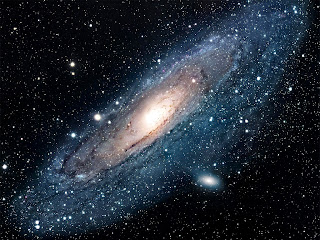
A Pretty picture of the Andromeda galaxy ( via Nasa)

Subscribe to:
Posts (Atom)